Skip to content
Radiographic Evidence of Compositional Evolution (Pentimenti)
In technical art history, the presence of genuine pentimenti (underlying alterations made during the painting process) serves as a primary material diagnostic for distinguishing an original invention from a secondary copy. A reproductive copyist mechanically transfers a stabilized, pre-fixed contour. Conversely, an originating master develops the forms organically directly upon the support, leaving a physical record of active visual problem-solving embedded within the paint strata.
Industrial X-radiography executed at Studio Västsvensk Konservering (SVK) demonstrates that the Domitian (Version 1) contains extensive structural and anatomical revisions beneath the surface. Paintings conservators Anna Bronzoni Catellani and Nina Olivier have independently verified these underlying changes.
Documented Revisions in the Compositional Layout
The radiographic mapping isolates several major areas where the composition was continuously rethought, corrected, and altered during execution:
The Facial Profile and Nose: Significant radiographic differences exist immediately before the facial profile. The X-ray data records a deliberate structural modification of the anatomy, showing that the artist reduced the overall head size and altered a straighter, linear nose into a more pronounced, crooked imperial form.
The Back of the Head, Neck and Hair: The X-ray images show clear changes to the back of the head, the neck, and the hair. The underlying layers show that the portrait originally had long hair visible at the nape of the neck, before the artist changed the neck and the size of the hair.
The Shoulder Contour: The X-ray images show that the position and slope of the Emperor’s shoulder and the accompanying costume were moved downward. The artist repositioned these areas to change the figure’s overall posture and physical size.
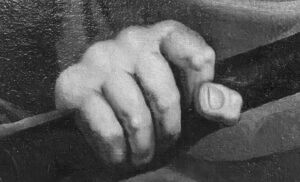
The Imperial Baton: The staff was originally larger and subsequently reduced in girth and length.
Methodological and Chronological Distinction
To maintain a strict academic standard, a precise distinction must be made between original pentimenti and subsequent interventions. Advanced multi-disciplinary tracking shows that while certain areas—such as the laurel wreath region—contain local, later touch-ups (independently verified by the presence of post-1704 Prussian blue), the deep revisions to the face, cranial mass, and torso belong to the primary, early painting campaign.
The absence of the ”L da Vinci” inscription on the X-ray plates further corroborates this material discipline. Because carbon-based black pigments have a low X-ray absorption compared to heavy lead-based matrices, the inscription’s radiographic transparency confirms it is not a heavy modern surface addition, but an integrated carbonaceous component consistent with old paint stratigraphies.
Conclusion
The cumulative radiographic record proves that the visible image of the Domitian is not a static, derivative transfer. The extensive pentimenti in major structural zones demonstrate that the painter was solving formal problems directly on the canvas. This behavior is fundamentally irreconcilable with the mechanics of a routine imitation and reinforces the status of Version 1 as a primary Renaissance creation.