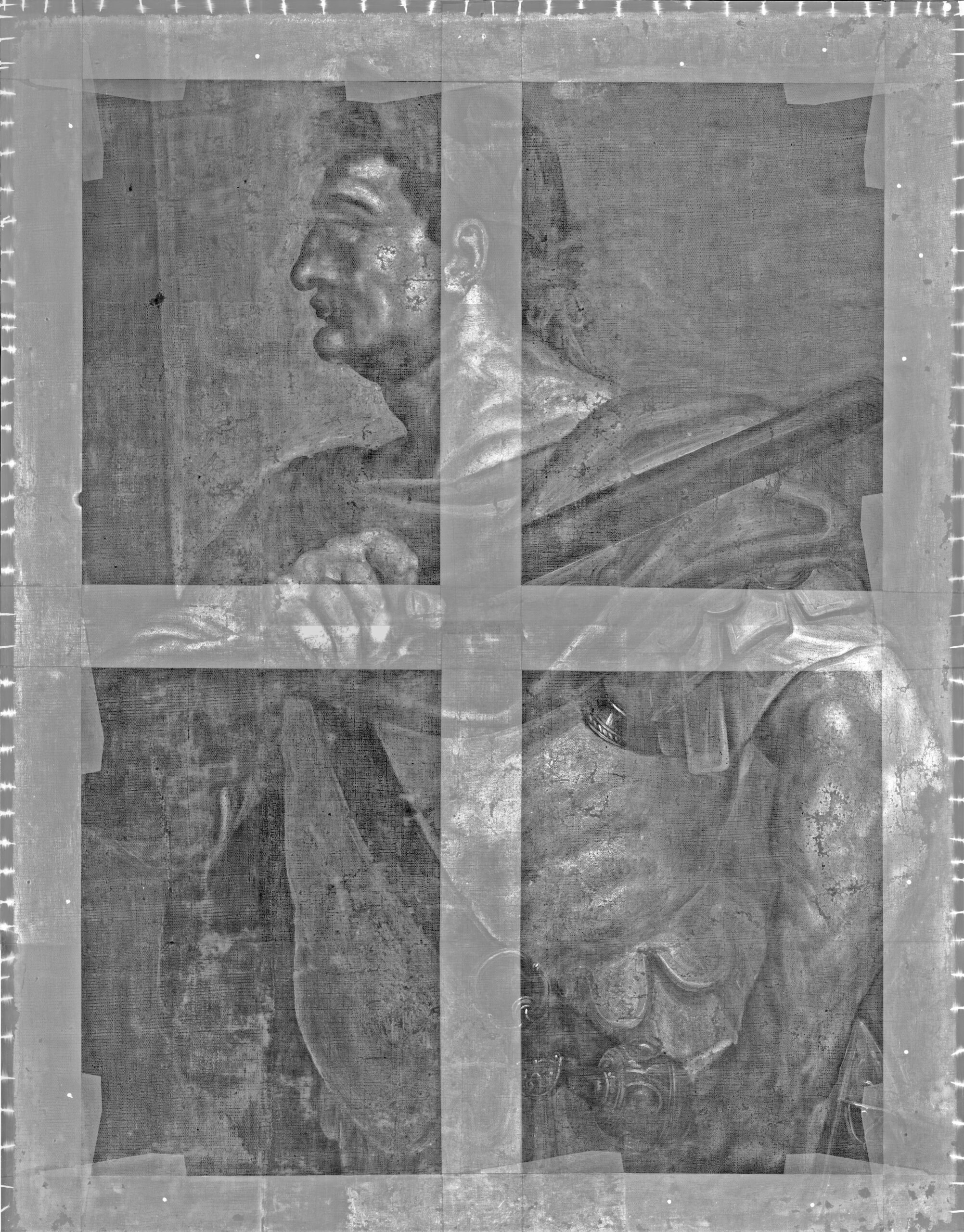
To evaluate the internal material history and macro-structural development of Version 1 (the investigated Domitian painting), full-scale digital industrial X-radiography (CR) was deployed. This technical methodology penetrates dense surface pigments, revealing the primary structural markers, historical interventions, and underlying paint strata embedded beneath the final composition.
The technical radiographic imaging campaign was executed in July 2019 at Studio Västsvensk Konservering (SVK), Gothenburg, by archaeological conservator Inger Nyström Godfrey, who operated the specialized industrial imaging equipment. The primary, explicit objective of the 2019 radiography was to determine whether the canvas support contained a hidden, pre-existing or discarded painting beneath the visible surface.
While the initial technical inspection focused on this baseline query and mapped physical damages, the high-resolution raw radiographic datasets were subsequently submitted for advanced art-historical diagnostics. The detailed analytical tracking of the uncompressed data matrices and the verifications of the underlying pentimenti have been independently conducted by specialized paintings conservators Anna Bronzoni Catellani and Nina Olivier.
The raw data recovered across the 12 integrated X-ray plates yields crucial material evidence that shapes the technical assessment of the artwork:
Absence of a Underlying Composition: The radiographs successfully resolved the primary research question, confirming that the canvas support does not contain any traces of an underlying, older painting. The work belongs entirely to a single, focused execution campaign.
The Armor Edge Pentimento: The radiographs reveal a distinct structural variation in the costuming; the shape of the lower armor edge appears visibly more pointed on the final painted surface than the baseline structure recorded on X-ray plate 8.
The Inscription Micro-Environment: A separate, dedicated radiograph was executed over the lower-left signature area. The inscription was entirely transparent under X-ray penetration, physically demonstrating that the lettering was executed with a low-density pigment of organic origin (carbon black), rather than a heavy, modern mineral paint.
Unresolved Hidden Geometry: X-ray plate 4 isolates a faint, straight underlying shadow positioned just above the emperor’s wrist near the sword hilt—a structural form embedded within the deeper layers that is completely absent from the visible surface.
The Laurel Wreath Variance: The imaging isolates a clear chronological discrepancy in the laurel wreath, which displays significantly more leaves on the visible surface than are physically recorded on X-ray plate 5, proving subsequent historic touch-ups.
Methodological Evolution and Connoisseurship
Because the initial 2019 radiography was strictly designed to test for an underlying composition, the broader art-historical implications regarding active, design-level pentimenti were not the focus of the initial report. The subsequent, independent evaluation of the raw DICOM datasets by specialized paintings conservators Anna Bronzoni Catellani and Nina Olivier successfully expanded upon the initial baseline, isolating the primary Renaissance alterations made to the overall profile, cranial boundaries, and imperial baton.