Architectural Divergence from the Sadeler Graphic Tradition
The relationship between Version 1 (the investigated Domitian painting) and Aegidius Sadeler’s famous reproductive engraving is one of the most critical diagnostic markers for separating an active Renaissance painting process from the later, standardized copy traditions.
The Standardized Visual Line vs. Active Invention
While the overarching composition remains aligned, a precise structural and proportional analysis reveals a fundamental divergence between the two works:
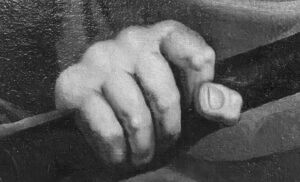
Proportional and Slant Variations: The digital overlay analysis demonstrates significant structural shifts, most notably in the internal geometry of the torso and the distinct, more fluid slope of the imperial baton in Version 1.
Absence of Graphic Standardization: The intricate surface decorations on the muscle cuirass detailed in Sadeler’s engraving are entirely absent from Version 1. Crucially, however, these exact graphic decorations are meticulously repeated on virtually all other surviving historical copies, known collectively as the Version 2 tradition (including the Uppsala and Bolsover series) spanning the 16th and 17th centuries.
The Evolutionary Genealogy
This structural divergence between the versions carries profound art-historical weight. The strong correlation between the painted cycles of Version 2 and the engraving demonstrates that these later works belong to a mechanical reproductive lineage that mirrors the Sadeler type. Conversely, Version 1 stands entirely independent of this tradition, a position supported by research suggesting that Sadeler may have worked from secondary copies rather than the original. This accounts for why the prints omit authentic characteristics while introducing standardized embellishments. Instead of mechanical copying, Version 1 functions as an original work marked by active visual problem-solving, which is confirmed by the underlying pentimenti that reveal a fluid creative process. These structural anomalies confirm that the painting belongs to an older, organic phase that predates the rigid standardization of the seventeenth century.
Comparative Visual Analysis and Overlay Data
The following photographic series and digital transparent overlays demonstrate the structural conformity of the historical Version 2 copies to Sadeler’s engraving, contrasted against the proportional and fluid independence of the Version 1 painting.